Introduction
Many declined applications are not caused by one major issue.
Instead, they result from several smaller risk markers that together make lenders nervous.
The good news?
Many of these red flags can be identified early.
Here are some common credit-report and application issues worth checking before finance is submitted.
Key Takeaways
- A strong income and good credit score don’t always guarantee approval.
Lenders assess the full financial picture, including repayment history, credit enquiries, BNPL use, defaults, and overall risk indicators.
- Many application declines are caused by multiple small red flags rather than one major issue. Issues such as recent credit enquiries, late payments, ATO debt, cashflow pressure, or document inconsistencies can combine to create lender concerns.
- Identifying issues early gives clients more time to check, explain or correct information before an application is submitted.
Checking potential issues early may reduce avoidable delays and unanswered questions during the application process.
Why lenders look beyond the credit score
A credit score is a summary calculated from information held in a credit report. It is not a complete explanation of someone’s financial position.
MoneySmart explains that a score may be affected by factors including the amount borrowed, the number of credit applications made and whether repayments were made on time. Lenders may also apply their own policies, serviceability models and assessment processes.
Source: https://moneysmart.gov.au/managing-debt/credit-scores-and-credit-reports
Under Australia’s comprehensive credit reporting system, a credit report may contain information about current credit accounts, repayment history, defaults, financial hardship arrangements and credit enquiries.
This gives a lender more information than a score alone. It may reveal patterns that need explanation, even where the overall score appears reasonable.
For example, a person may have stable employment and a healthy score but several recently missed credit card repayments. The lender may focus more closely on the repayment pattern than the score alone.
The outcome will depend on the lender, product, application and wider circumstances. A score should therefore be treated as one part of the picture, not a guaranteed pass or fail signal.
FBC’s guide to comprehensive credit reporting in Australia provides further background on the information that can appear.
Common credit report red flags to check before an application
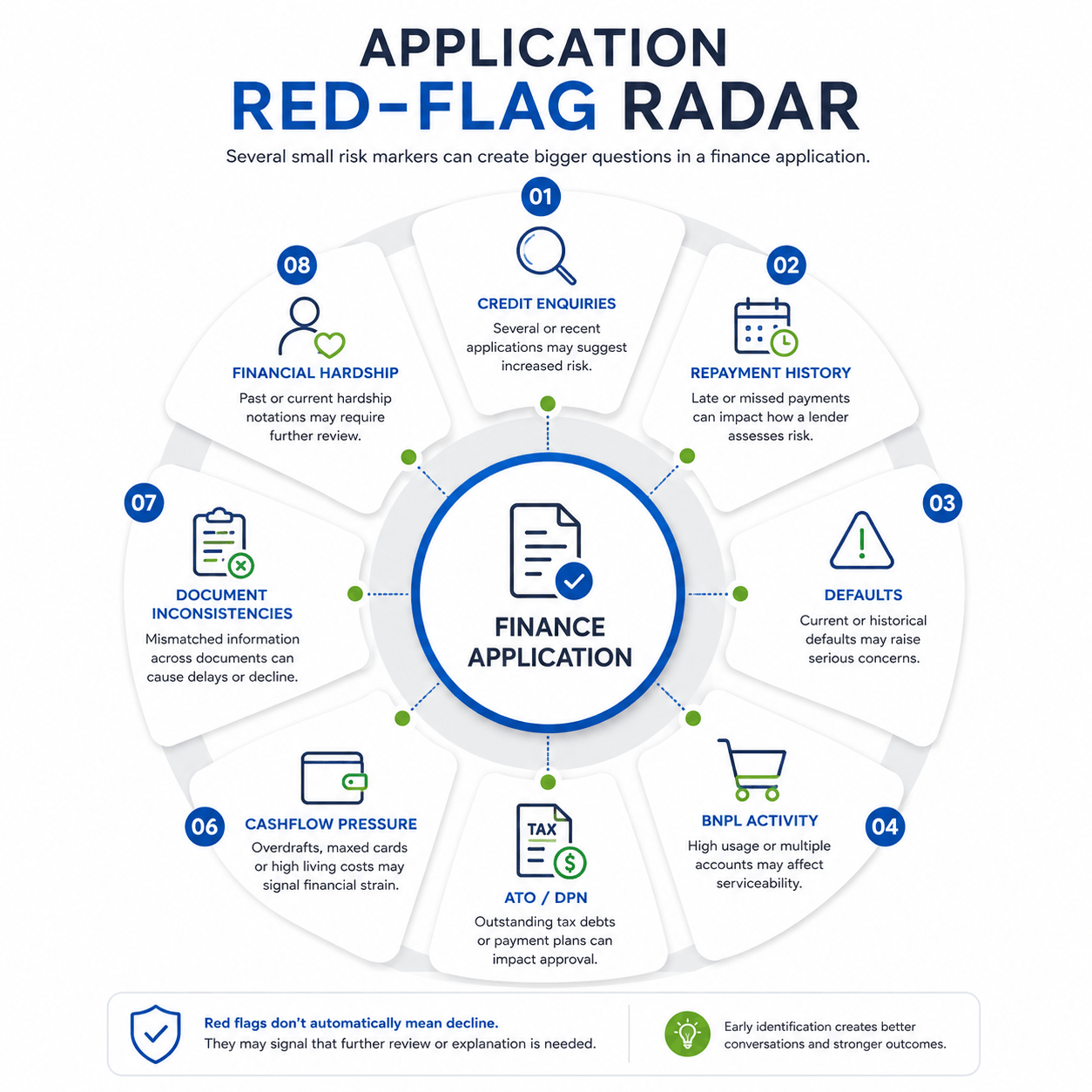
A finance application may look strong at first, but smaller issues across the credit report and supporting documents can still raise questions. These red flags do not automatically mean a client will be declined, but they may signal that more information, clarification, or review is needed before the application proceeds.
Red flag 1: Multiple credit enquiries in a short period
Credit enquiries may appear when a person applies for credit and a credit provider accesses their credit information for an authorised purpose.
MoneySmart lists many recent credit applications as one factor that may contribute to a lender declining an application.
Source: https://moneysmart.gov.au/loans/loan-rejection
The Office of the Australian Information Commissioner (OAIC) states that credit enquiries can generally remain on a credit report for five years.
What to check
- Several applications made close together
- Applications across different types of credit
- Enquiries the client does not recognise
- Applications not disclosed during the client discussion
- Repeated short-term or small-amount lending enquiries
For example, a client may have applied for two credit cards, car finance and a personal loan within a short period. Each enquiry may have an explanation, but the group may attract further questions.
There is no universal number of enquiries that automatically causes a decline. Lender policies differ, so using any fixed “safe” or “unsafe” number should be avoided.
Hard and soft enquiries
“Hard enquiry” is commonly used to describe an access connected with a credit application. These enquiries may be included in the credit report and used as part of credit assessment.
“Soft enquiry” is an industry term often used for other checks, such as a person viewing their own credit information. However, terminology and display methods can differ between credit reporting bodies.
Everyone has a right to request a free copy of their credit report every three months. They may also obtain a free report after being refused credit or after credit information has been corrected.
Source:https://www.oaic.gov.au/privacy/your-privacy-rights/credit-reporting/access-your-credit-report
Red flag 2: Repayment history issues
Repayment history information, commonly called RHI, shows whether payments on eligible consumer credit accounts were made on time.
The OAIC explains that a payment can be recorded as missed where it is made more than 14 days after the due date. RHI generally remains on a credit report for two years.
Source: https://www.oaic.gov.au/privacy/your-privacy-rights/credit-reporting/repayment-history-and-defaults
What to check
- Several late-payment markers
- A recent change from regular payments to missed payments
- Different accounts falling behind in the same period
- RHI that does not match the client’s payment records
- Repayment history that does not appear to reflect the terms of an agreed payment arrangement.
One isolated missed payment does not have a guaranteed effect. However, repeated or recent late payments may raise questions about whether the issue was temporary, whether it is ongoing, and whether current commitments are being maintained.
Consider a client who missed several credit card repayments during a period of reduced work. The account may now be current, but the earlier repayment pattern can still appear in the credit report.
The key task is not to guess how a lender will respond. It is to check whether the dates and account information are accurate and whether supporting records explain what happened.
Red flag 3: Defaults
A default is not the same as one ordinary late payment.
The OAIC explains that a credit provider can generally report a default when the overdue amount is at least $150; the payment has been overdue for at least 60 days, and the required notices have been sent.
Source: https://www.oaic.gov.au/privacy/your-privacy-rights/credit-reporting/repayment-history-and-defaults
Defaults can generally remain on a credit report for five years. Paying a correctly listed default does not automatically remove it, although the payment status should be updated.
What to check
- Paid and unpaid defaults
- Telco or utility defaults the client had forgotten
- Incorrect balances or payment status
- Duplicate listings
- Dates that do not match the account records
- Missing or disputed notices
- Accounts the client does not recognise
A small telco default may still require attention. The dollar value is only one part of the picture. Its age, payment status, surrounding circumstances, and accuracy may also be relevant.
FBC’s guide to understanding credit defaults explains what a default means and how long it may remain.
What about a serious credit infringement?
A serious credit infringement is a separate category from a default and has specific legal requirements. An unpaid or unfamiliar account should not automatically be described as a serious credit infringement. If one appears on a credit report, the underlying circumstances and reporting requirements should be checked carefully.
Red flag 4: Multiple or unexplained BNPL commitments
Buy Now Pay Later products are now regulated as credit products under Australia’s updated credit framework.
Since 10 June 2025, BNPL contracts have been regulated under Australia’s consumer credit laws. Many BNPL products fall within the low cost credit contract framework.
Modified responsible-lending obligations may apply to qualifying low-cost credit contracts.
Source: Read ASIC’s BNPL regulatory guidance.
What to check
- Several active BNPL facilities
- Frequent BNPL deductions in bank statements
- Missed or dishonoured BNPL payments
- BNPL being used for normal household costs
- New accounts opened shortly before the finance application
- Differences between disclosed facilities and statement activity
A client may have four active BNPL accounts while earning a stable income. That does not establish financial difficulty by itself.
However, repeated deductions, missed payments or regular use for groceries and bills may require a closer conversation about current commitments and cashflow.
The effect of BNPL use varies between lenders, products and client circumstances. Simply having a BNPL account does not guarantee a decline.
Red flag 5: ATO debt and DPNs
ATO debt may be relevant when the client is a business owner or company director.
An ATO payment arrangement does not automatically mean a business is failing. However, a growing balance, missed arrangement payments or outstanding lodgements may require explanation.
A Director Penalty Notice (DPN) is more serious than an ordinary payment reminder. Under the director penalty regime, a director may become personally liable for certain unpaid company obligations in defined circumstances.
What to check
- An active ATO payment arrangement
- A balance that continues to increase
- Missed payments under an arrangement
- Outstanding BAS or tax lodgements
- Director Penalty Notice correspondence
- Different ATO balances across documents
- Business debt being supported by personal borrowing
A business may have strong turnover while still carrying tax debt. Turnover alone does not show whether the debt is reducing or whether current obligations are being met.
A useful factual question is:
Has the balance been reducing over time?
The answer will not decide the finance application, but it may help it may help show whether the obligation is reducing or continuing to grow.
Red flag 6: Cashflow pressure and repeated reliance on short-term credit
Bank statements can show how a client manages day-to-day expenses, not only how much income enters the account.
Use of short-term credit does not by itself establish financial difficulty, but repeated reliance on it may warrant closer review of cash flow and existing commitments.
ASIC continues to regulate small-amount credit contracts and has raised concerns about unsuitable contracts and attempts to avoid consumer protections in parts of the payday lending market.
What to check
- Wage-advance use several times each month
- Frequent payday-loan repayments
- Regular overdraft use
- Repeated dishonour fees
- Credit being used for ordinary bills
- One short-term facility being replaced with another
For example, a client may use a wage-advance service near the end of every pay cycle to cover groceries and utilities. This does not confirm that the client cannot afford new finance, but it may justify a careful review of recurring expenses and current commitments.
If the pattern suggests broader financial difficulty, the client may need advice from an appropriately qualified professional.
Red flag 7: Inconsistent information
A credit report is only one part of an application file.
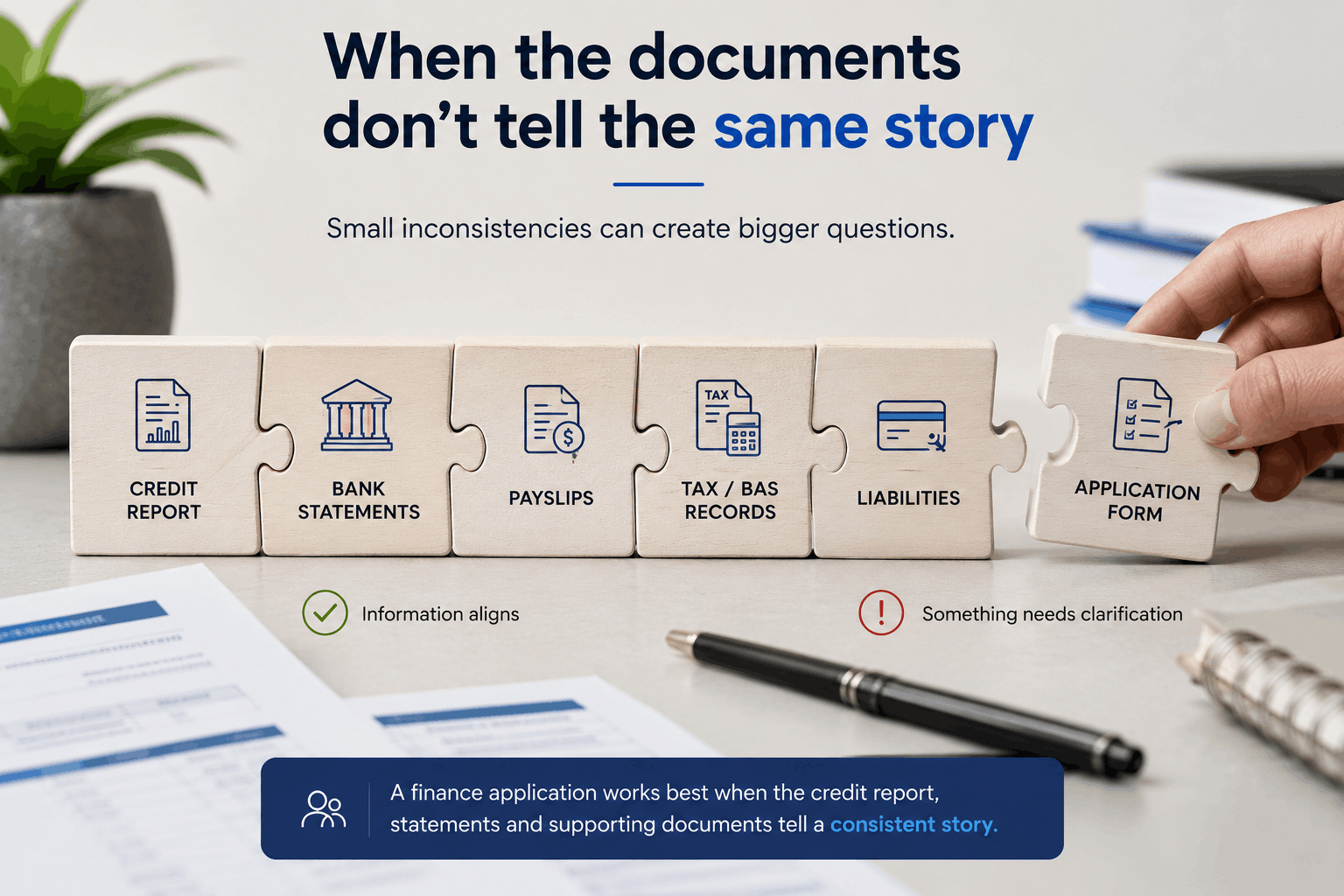
Payslips, bank statements, tax returns, BAS records, identification and application forms should tell a reasonably consistent story. Differences may be legitimate, but unexplained differences can cause delay or further questions.
What to look for
- Different residential addresses
- Employer details that do not align
- Income figures using different periods
- Undisclosed debts visible in statements
- Different business turnover figures
- Missing pages or incomplete statements
- Name variations that may connect the wrong account
For example, a payslip may show base salary while the application includes irregular overtime. Bank statements may show another average because of unpaid leave or changing hours.
This does not automatically mean the client supplied false information. It may simply mean that different figures were calculated in different ways. The safest approach is to identify and explain the difference rather than leaving the assessor to discover it.
It is also important to check that credit-report entries belong to the correct person.. Identity matching errors, duplicate listings and accounts affected by fraud may require a formal correction request.
Red flag 8: Recent financial hardship information
Financial hardship information is not evidence that someone has done something wrong. It records that an agreed hardship arrangement affected the person’s repayment obligations.
The credit report does not disclose why the person needed hardship assistance. A credit reporting body also cannot use financial hardship information when calculating a credit score.
The important question before an application is whether the information is accurate and whether the client’s current circumstances are properly understood.
What to check
- whether the hardship information matches the agreed arrangement
- whether RHI reflects the repayments required under the arrangement
- whether the arrangement has ended
- whether relevant confirmation letters and statements are available
- whether any information appears incorrect or inconsistent
A client may have entered hardship after losing work and later returned to stable employment. The hardship information does not explain the job loss, recovery or current position.
This is why records matter. Confirmation letters, account statements and proof of payments can help explain what was agreed and whether the credit report accurately reflects that agreement.
FBC’s guide to Hardship arrangements: what they are, how they show up, and what to ask your lender explains these indicators in more detail.
Pre-application credit checklist
Before an application is submitted, a structured review can help identify information that may need checking, explanation or correction.
1. Review the credit report
- Obtain and review the complete credit report
- Check personal information and address history
- Identify recent credit enquiries
- Review RHI across eligible accounts
- Check defaults and their payment status
- Look for hardship information
- Ask about unrecognised or disputed accounts
2. Review liabilities and account activity
- Confirm active loans, credit card limits and BNPL facilities
- Review short-term lending activity
- Check overdraft and dishonour patterns
- Identify ATO and business liabilities
- Confirm whether payment-plan balances are reducing
- Compare disclosed debts with bank-statement deductions
3. Review supporting records
- Confirm income figures use the correct period
- Compare employment details across documents
- Check names, dates and addresses
- Review missing pages or incomplete records
- Record explanations for genuine inconsistencies
- Keep relevant letters, statements and payment receipts
This checklist cannot predict a lender’s decision. Its purpose is to identify information that may require checking, explanation or correction.
What can be reviewed or corrected before submission?
Not every negative entry can or should be removed.
Accurate information may lawfully remain on a credit report for the applicable retention period. However, information may need to be investigated when it is incorrect, out of date, duplicated, connected to fraud or reported without meeting the relevant requirements.
Under the Privacy Act and Credit Reporting Code, individuals can request correction of their credit-related personal information. The Credit Reporting Code generally provides a 30-day correction period, although a longer period may be agreed in some circumstances. If the matter cannot be resolved through the initial correction or internal dispute resolution process and progresses to AFCA, resolution can take considerably longer.
Source:
https://www.oaic.gov.au/privacy/privacy-registers/privacy-codes/privacy-credit-reporting-code-2024
How Fix Bad Credit can help
Fix Bad Credit can assist by:
- Reviewing the client’s credit report and identifying the information in dispute.
- Assessing the circumstances surrounding defaults, repayment history, financial hardship information, credit enquiries and other adverse credit information.
- Reviewing available statements, notices, payment records and correspondence.
- Identifying information or evidence that may need to be obtained from the credit provider or credit reporting body.
- Preparing and managing correction requests and disputes with the relevant organisation.
- Reviewing responses and supporting documents to determine whether the issue has been adequately addressed.
- Where appropriate, progressing unresolved eligible complaints through internal dispute resolution or the Australian Financial Complaints Authority (AFCA).
AFCA provides an independent external dispute resolution service for eligible complaints involving financial firms, including complaints relating to credit, finance and loans. If a matter needs to progress to AFCA, the dispute process can take considerably longer than the initial correction or internal dispute resolution stage, depending on the complexity of the matter, the evidence required and how the complaint progresses.
For brokers and other referral partners, this means you do not need to determine whether an adverse credit entry can be removed before referring a client. If something on a client’s credit report appears incorrect, unexplained or potentially problematic, Fix Bad Credit can review the circumstances and advise on the available options.
A correction request is not simply a request to delete accurate negative information. Whether information can or should be changed depends on the facts, available evidence and the credit reporting requirements that apply.
Mini case study: Jamie’s unexpected telco default
Jamie was excited to buy his first home when his broker spotted an old telco default on his credit report. Jamie was confused because he believed the service had been closed years earlier and did not understand how the remaining balance had been reported. Left unaddressed, the listing had the potential to complicate his finance application and create unnecessary delays.
Rather than moving forward with unanswered questions, his broker referred him to Fix Bad Credit. With Jamie’s permission, the team reviewed his credit report and supporting information, identified the details requiring clarification, and contacted the credit provider on his behalf.
The outcome came far sooner than Jamie expected. Within just 24 hours of commencing the case, the telco default was successfully removed. Jamie was “fan-bloody-tastic” and said he “wouldn’t be able to do it without” the Fix Bad Credit team. With a clean credit report, he could continue his journey towards buying his first home with greater confidence and later planned to refinance with his partner.
For mortgage brokers, finance brokers and referral partners, Jamie’s experience is a reminder that an old telco default should not always be accepted at face value. Early review and clarification can provide valuable context before a finance application progresses.
As with every case, any correction or outcome depends on the individual circumstances, available evidence, credit reporting requirements, and the credit provider’s assessment.
How Fix Bad Credit supports referral partners
Not every red flag is an error, and not every accurate negative entry can be changed.
Fix Bad Credit works with referral partners to help identify and address credit report concerns before they become last-minute surprises in the finance process.
For brokers and other referral partners, this means you do not need to determine whether an adverse credit entry can be corrected before referring a client. If something on a credit report appears incorrect, unexplained or potentially problematic, we can review the circumstances and advise on the available options.
We can also work alongside the client’s authorised referral partner, helping keep them informed about the issue, the steps being taken and any potential impact on timing.
Where a matter requires escalation beyond the initial correction or internal dispute resolution process, including to AFCA, resolution can take considerably longer. Early referral can therefore be particularly important where a client is preparing to apply for finance.
What can be achieved depends on the facts, available evidence, applicable credit reporting requirements and, where relevant, creditor policies.
We cannot guarantee that information will be removed or changed, and the relevant lender remains responsible for its own credit assessment and lending decision.
Final thoughts
A red flag does not automatically mean an application will be declined. It may simply identify something that needs to be checked, explained or corrected.
Reviewing the information early gives the client and broker more time to understand what appears on the credit report and gather any supporting records that may be needed.
The goal is not to make a file look artificially perfect. It is to make sure the information being relied on is accurate and properly understood.
Frequently asked questions
1. What is the biggest reason finance applications get declined?
There is no single biggest reason across every lender and product.
MoneySmart identifies factors such as late repayments, unpaid debts, recent credit applications, defaults and serious credit infringements. Income, expenses, liabilities, loan type and lender policy may also be relevant.
A combination of smaller issues may sometimes create more concern than one isolated entry.
2. Do lenders look at more than a credit score?
Yes. A credit score summarises information from a credit report, but it does not replace the full assessment.
Lenders may review the credit report, repayment history, current debts, income, expenses, bank statements and supporting records. Their exact assessment methods and policies differ.
3. Can a paid default still affect a finance application?
Yes. A paid default can remain visible on a credit report for five years from the date it was listed. Its status should be updated to show that it has been paid.
Whether it affects a particular application depends on the lender, product and surrounding circumstances. There is no guaranteed outcome.
4. What should brokers review before submitting an application?
A useful review may cover the complete credit report, repayment history information, recent enquiries, defaults, financial hardship information and current liabilities.
They may also compare the application with bank statements, payslips, tax records and other supporting documents. The aim is not to predict the lender’s decision. It is to identify information that appears inconsistent, unexplained or potentially inaccurate.
5. When should a client be referred for credit assistance?
A referral may be useful where a client does not recognise an account, disputes information on their credit report, believes repayment or default information is incorrect, or wants help gathering evidence and communicating with the relevant organisation.
A review can clarify the available options but does not guarantee that an entry will be changed or removed.