A business can look healthy on the surface - until a (DPN) appears
Imagine a business owner who has plenty of work, loyal customers, and plans to expand.
The numbers look strong. The business appears successful. Then a lender discovers the director has received a Director Penalty Notice (DPN).
Suddenly, the conversation changes.
Questions that were never asked before start appearing.
What is the current ATO debt? How long has it been outstanding? What other financial pressures might exist?
For mortgage brokers, commercial finance brokers, accountants, and advisers, this is a situation that occurs more often than many realise.
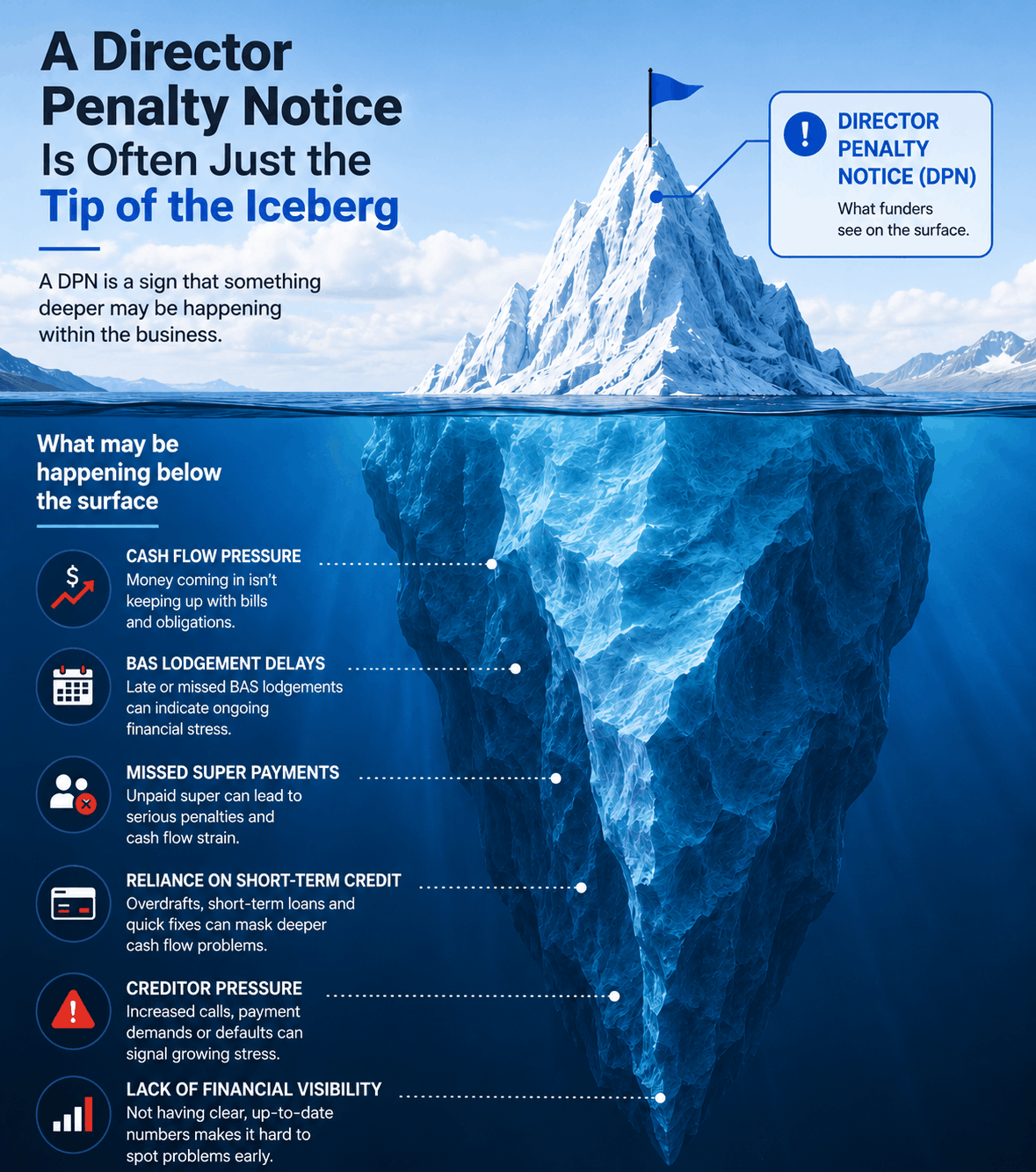
A DPN is not always the problem itself.
Often, it is a signal that something deeper may be happening behind the scenes.
Understanding those signals can help identify potential issues earlier and create more opportunities for clients before financial pressure escalates.
Key Takeaways
- A Director Penalty Notice may indicate underlying cash flow or tax-payment challenges within a business.
- Funders often view (DPNs) as risk markers because they can suggest broader financial pressure.
- Early action may provide business owners with more options than waiting until problems become severe.
What is a Director Penalty Notice?
A Director Penalty Notice (DPN) is a formal notice issued by the Australian Taxation Office (ATO). It can make company directors personally liable for certain unpaid company tax obligations.
According to the ATO, director penalties may apply to unpaid:
- PAYG withholding amounts
- Goods and Services Tax (GST)
- Superannuation Guarantee Charge (SGC)
Source: https://www.ato.gov.au
The purpose of the (DPN) regime is to encourage directors to meet their company’s tax obligations and address problems early.
A DPN should never be ignored.
However, receiving one does not automatically mean a business is insolvent, nor does it mean finance is impossible. It simply means further investigation is usually required.
If you’re unfamiliar with credit-related records and reporting systems, our guide to what is credit repair explains how Australians can better understand and review their credit information.
Partner insight
Many brokers first learn about ATO debt only after a finance application has already commenced.
By this stage, the lender may already have concerns about the client’s overall risk profile.
Early discovery often creates more flexibility than last-minute explanations.
Why funders get nervous when they see a (DPN)
Funders assess risk.
A DPN can raise concerns because it suggests the business may have struggled to meet important financial obligations.
From a funder’s perspective, several questions may arise:
- Is cash flow under pressure?
- Have tax obligations been delayed repeatedly?
- Are other creditors also unpaid?
- Could there be future repayment difficulties?
A DPN does not automatically result in a declined application.
However, it often triggers additional scrutiny.
Many lenders view tax debt differently from ordinary business expenses because tax obligations are generally considered essential obligations of the business.
Current business pressure across Australia
Australian businesses continue to face challenging conditions.
According to ASIC, company insolvencies have increased significantly over recent years as higher operating costs, inflation, wage growth, and interest rate pressures affect business cash flow.
Source: https://asic.gov.au
Similarly, CreditorWatch reports ongoing increases in payment defaults and business failures across several industries.
Against this backdrop, funders have become increasingly cautious when assessing risk indicators.
5 hidden business problems a (DPN) may be signaling
A DPN is often the symptom rather than the cause. Several underlying issues may contribute to a business receiving one.
1. Cash flow challenges
Many businesses remain profitable but experience cash flow problems.
A construction business, for example, may have substantial work in progress but still struggle to pay bills if customers pay late.
2. Rising operating costs
Business owners across Australia continue to face increasing:
- Wages
- Insurance costs
- Fuel costs
- Supplier costs
- Interest expenses
When cash becomes tight, tax obligations are sometimes pushed back.
3. Poor financial visibility
Some business owners are unaware of how quickly tax debt is growing.
Without regular financial reporting, problems can build quietly over time.
4. Reliance on short-term credit
Increasing use of:
- Overdrafts
- Short-term business finance
- Merchant cash advances
- Unsecured business loans
May indicate growing financial pressure.
5. Referral trigger
Consider a referral conversation if a client:
- Has growing ATO debt
- Regularly lodges BAS late
- Has unpaid super obligations
- Frequently applies for finance
- Appears unsure of their current financial position
These indicators may suggest broader credit or financial issues requiring review.
How (DPNs) can affect funding conversations
A DPN may influence multiple types of finance discussions.
1. Commercial lending
Commercial lenders may ask additional questions regarding:
- Tax liabilities
- Repayment arrangements
- Cash flow
- Financial reporting
Business owners looking to strengthen their financial positions before applying for finance may benefit from understanding how to fix bad credit for business loans and why credit quality matters to funders.
2. Equipment finance
Funders may seek additional evidence regarding:
- Current liabilities
- Profitability
- Outstanding obligations
3. Working capital facilities
Businesses seeking working capital may face closer examination if tax debt exists.
4. Home loans and refinancing
Business owners applying for personal finance may also encounter questions regarding:
- Business liabilities
- Personal guarantees
- Outstanding tax obligations
Every lender has different policies. The existence of a DPN alone does not determine an outcome.
6 warning signs brokers and accountants should watch for
Professionals often identify warning signs before the business owner seeks help.
Key indicators include:
1. Growing ATO debt
ATO debt increasing each quarter may indicate cash flow pressure.
2. Repeated BAS delays
Frequent delays may suggest underlying financial management challenges.
3. Missed super payments
Unpaid superannuation can become a serious concern for both employees and regulators.
4. Multiple credit applications
Repeated applications may indicate difficulty obtaining finance.
5. Short-term debt reliance
Using one form of debt to manage another may suggest worsening financial pressure.
6. Creditor contact increasing
Collection notices and payment demands may indicate mounting obligations.
Partner Insight
Most clients do not deliberately hide financial problems.
Often, they are embarrassed, overwhelmed, or unsure how serious the situation has become.
Simple questions asked early can reveal important information.
What business owners should do if they receive a DPN
Receiving a DPN can feel confronting. However, taking action early is usually preferable to waiting.
General steps may include:
1. Read the notice carefully
Understand what the notice relates to and any relevant dates.
2. Speak with your accountant
Clarify outstanding liabilities and obligations.
3. Obtain professional advice
Appropriate legal, tax, or financial professionals can explain available options.
4. Review cash flow
Understand:
- Money coming in
- Money going out
- Overdue obligations
5. Check your credit report
Understanding what appears on your credit report may help identify additional issues requiring attention.
6. Keep records
Maintain copies of:
- Notices
- Correspondence
- Repayment arrangements
- Financial documents
Why early action creates more options
There is a common pattern seen across financially stressed businesses.
Business Owner A ignores the issue.
Business Owner B addresses it immediately.
The second business owner typically has more information, more time, and more opportunities to address concerns before pressure escalates.
Early action does not guarantee any particular outcome. However, it often improves visibility and decision-making.
How Fix Bad Credit can help
While Fix Bad Credit does not provide legal or tax advice, we can assist clients in understanding the credit-report side of their situation.
Fix Bad Credit can deal directly with credit providers and credit reporting bodies to seek corrections, clarifications, or negotiated outcomes.
Outcomes depend on the facts, available evidence, and credit providers’ policies.
We help clients by:
- Reviewing credit reports
- Identifying possible inaccuracies
- Preparing correction requests
- Assisting with disputes
- Communicating directly with credit providers where authorised
- Helping clients better understand their overall credit position
Related reading:
Case Study: Declan’s financial turnaround
Declan, a business owner from Melbourne, was preparing to buy his first home when financial pressure began to mount.
While his business income was steady, cash flow was often tight around BAS periods, an ATO payment arrangement was in place, and defaults had appeared on his credit report. As he started working with a broker, he became increasingly worried these issues could affect his home loan application.
When Declanreached out to Fix Bad Credit, our team immediately reviewed his credit report, BAS records, and supporting documents to understand the full picture. We explained how repayment history, lending activity, and cash flow patterns may be viewed by lenders and funders, helping him better understand what was being reported.
The team worked directly with the relevant parties to address the issues in a structured way.
The outcome? Not only were the defaults removed, but Declan also gained greater clarity, confidence, and a clearer path towards his home ownership goals.
Financial challenges rarely improve through avoidance. Understanding the problem early often creates more opportunities than waiting until the pressure becomes overwhelming.

Common myths about DPNs
1. Myth: A DPN means the business is finished
Reality:
Many businesses recover from financial difficulties after taking appropriate action.
2. Myth: Profitable businesses don’t receive DPNs
Reality:
Cash flow problems can affect profitable businesses.
3. Myth: Lenders don’t care about tax debt
Reality:
Tax debt is often considered an important risk indicator.
4. Myth: Waiting improves the situation
Reality:
Delays often reduce available options.
5. Myth: Brokers should solve the issue alone
Reality:
Complex tax, legal, and credit matters may require specialist support.
Frequently Asked Questions About DPNs
1. Does a DPN automatically mean finance will be declined?
No. A Director Penalty Notice does not automatically cause a finance application to be declined, as lenders assess each application individually based on the business’s cash flow, tax debts, payment arrangements and overall financial position.
2. Can profitable businesses receive a DPN?
Yes. A profitable business can receive a DPN when it does not have enough available cash to pay tax or super obligations on time, often due to slow customer payments, seasonal income, rapid growth or unexpected expenses.
3. Does a DPN appear on a credit report?
A DPN does not necessarily appear as a separate entry on a director’s consumer credit report. However, related outcomes such as court judgments, recovery action or bankruptcy may affect the director’s financial position and require further investigation.
4. Can directors become personally liable?
Yes. Under Australia’s director penalty regime, directors may become personally liable for certain unpaid company obligations, including PAYG withholding, GST and Superannuation Guarantee Charge amounts.
5. Should business owners ignore a DPN if they are negotiating payment arrangements?
No. A DPN should be reviewed immediately, even when an ATO payment arrangement is being negotiated or followed, because strict deadlines may apply and the payment plan may not remove the director’s personal liability.